Operationalising the ICOMOS Charter on Cultural Heritage Tourism: From Principles to Practice
The ICOMOS International Charter for Cultural Heritage Tourism (ICCHT): Reinforcing cultural heritage protection and community resilience through responsible and sustainable tourism management was adopted by ICOMOS General Assembly in Bangkok, Thailand, November 2022. The 2022 Charter recognises the need to recalibrate tourism away from growth‑driven models toward heritage‑centred, rights‑based, and climate‑responsive management. Its operationalisation is advancing through a collaborative approach, and in 2026 most visibly involving the webinar series “From Principles to Practice” and launch of an online Charter Dossier supporting practical application of the charter principles.
The Charter at a glance: objectives and seven principles
The 2022 Charter explicitly responds to profound structural issues and disruptions affecting global tourism: overtourism, commodification and gentrification of heritage, inequitable benefit‑sharing, and the climate emergency. It reframes cultural heritage as commons whose governance and enjoyment are shared rights and responsibilities, placing community resilience and equitable outcomes at the core of tourism policy and projects.
The Charter sets three overarching objectives: (1) put heritage protection and community rights at the heart of tourism policy and projects; (2) promote stakeholder collaboration and participatory, rights‑based governance; and (3) align heritage‑tourism management with the UN Sustainable Development Goals and climate action. These objectives are set out through seven principles.
Charter Principles
Principle 1: Place cultural heritage protection and conservation at the centre of responsible cultural tourism planning and management.
Principle 2: Manage tourism at cultural heritage places through management plans informed by monitoring, carrying capacity and other planning instruments.
Principle 3: Enhance public awareness and visitor experience through sensitive interpretation and presentation of cultural heritage.
Principle 4: Recognise and reinforce the rights of communities, Indigenous Peoples, and traditional owners by including access and engagement in participatory governance of the cultural and natural heritage commons used in tourism.
Principle 5: Raise awareness and reinforce cooperation for cultural heritage conservation among all stakeholders involved in tourism.
Principle 6: Increase the resilience of community and cultural heritage through capacity development, risk assessment, strategic planning, and adaptive management.
Principle 7:Integrate climate action and sustainability measures in the management of cultural tourism and cultural heritage
The 2026 webinar series: “From Principles to Practice”
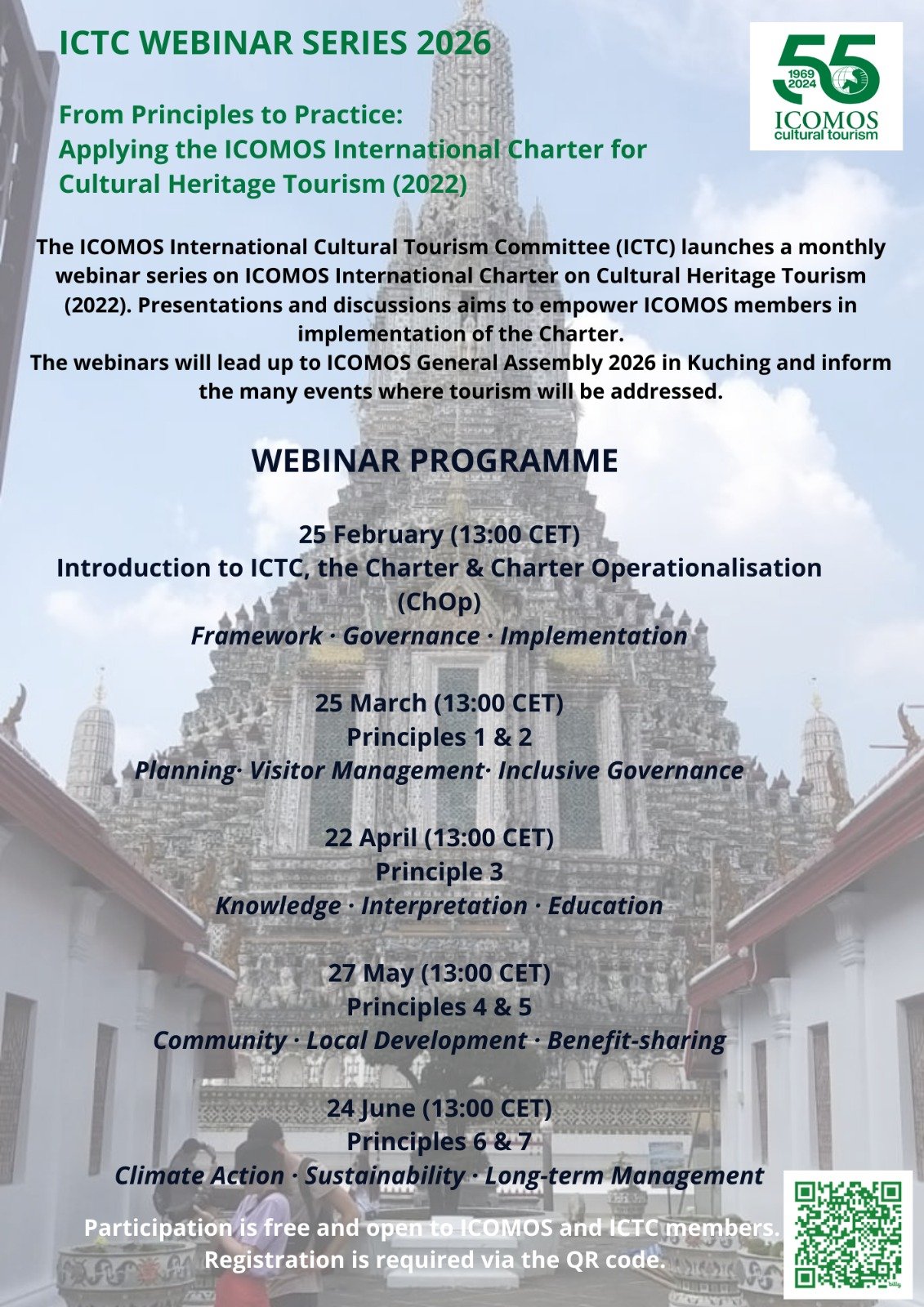
Between February and June 2026, the ICOMOS International Cultural Tourism Committee (ICTC) delivered a five-part monthly webinar series, From Principles to Practice, dedicated to operationalising the 2022 Charter and building momentum towards ICOMOS General Assembly October 2026 in Kuching, Malaysia and Scientific Symposium (Session 6). The series moved systematically through the Charter's seven principles, pairing conceptual framing by ICTC Bureau members with concrete case studies from around the world.
The programme mirrored the Charter’s integrated logic, progressing from governance and planning to community, education, and climate:
● Webinar 1, 25/2/26: Introduction to ICTC, the Charter, and Charter Operationalisation. Overview of ICTC’s mandate, the Charter’s objectives and structure, and the practical tools developed to support implementation.
● Webinar 2, 25/3/26: Principles 1 & 2: Planning · Visitor Management · Inclusive Governance. How to centre conservation in tourism planning; use management plans, monitoring, and carrying capacity; and embed participatory governance in visitor management.
● Webinar 3, 22/4/26: Principle 3: Knowledge · Interpretation · Education. Using research, documentation, and interpretation to enhance understanding while safeguarding cultural significance.
● Webinar 4, 27/5/26: Principles 4 & 5: Community · Local Development · Benefit‑sharing. Mechanisms to recognise community and Indigenous rights, strengthen local participation, and ensure equitable social and economic benefits (organised in collaboration with ICOMOS Africa).
● Webinar 5, 24/6/26: Principles 6 & 7: Climate Action · Sustainability · Long‑term Management. Strategies to integrate climate risk, resilience, and sustainability into long‑term heritage‑tourism policy and management frameworks.
The webinar series successfully covered all seven principles of the Charter through focused thematic sessions through presentation of concrete cross-regional case studies. It brought together ICOMOS members, emerging professionals and external partners, advancing collaboration with other organisations and networks, achieving substantial global reach including 476 unique registrants from over 100 countries across every world region.
The discussions demonstrated that operationalising the Charter cannot rely on a single model or universal solution. Application must respond to the community context, vulnerabilities, significance and governance of each heritage place. Across the series, recurring priorities included participatory governance, stronger monitoring, equitable benefit-sharing, locally appropriate capacity development, and the integration of climate action into long-term tourism and heritage management.
The recordings are available in the Charter Dossier, organised under the corresponding Charter principles (ChAp Webinars 2026). The curated body of recorded sessions and case-study material serves as a reference for ongoing dialogue, collaborative capacity development, and strategic operationalisation.
ICOMOS ICTC encourages everyone to explore the Charter Dossier for the full text along with the supplementary resources, and bring materials and perspectives into discussions, training or workshops to evolve shared understanding and practices.