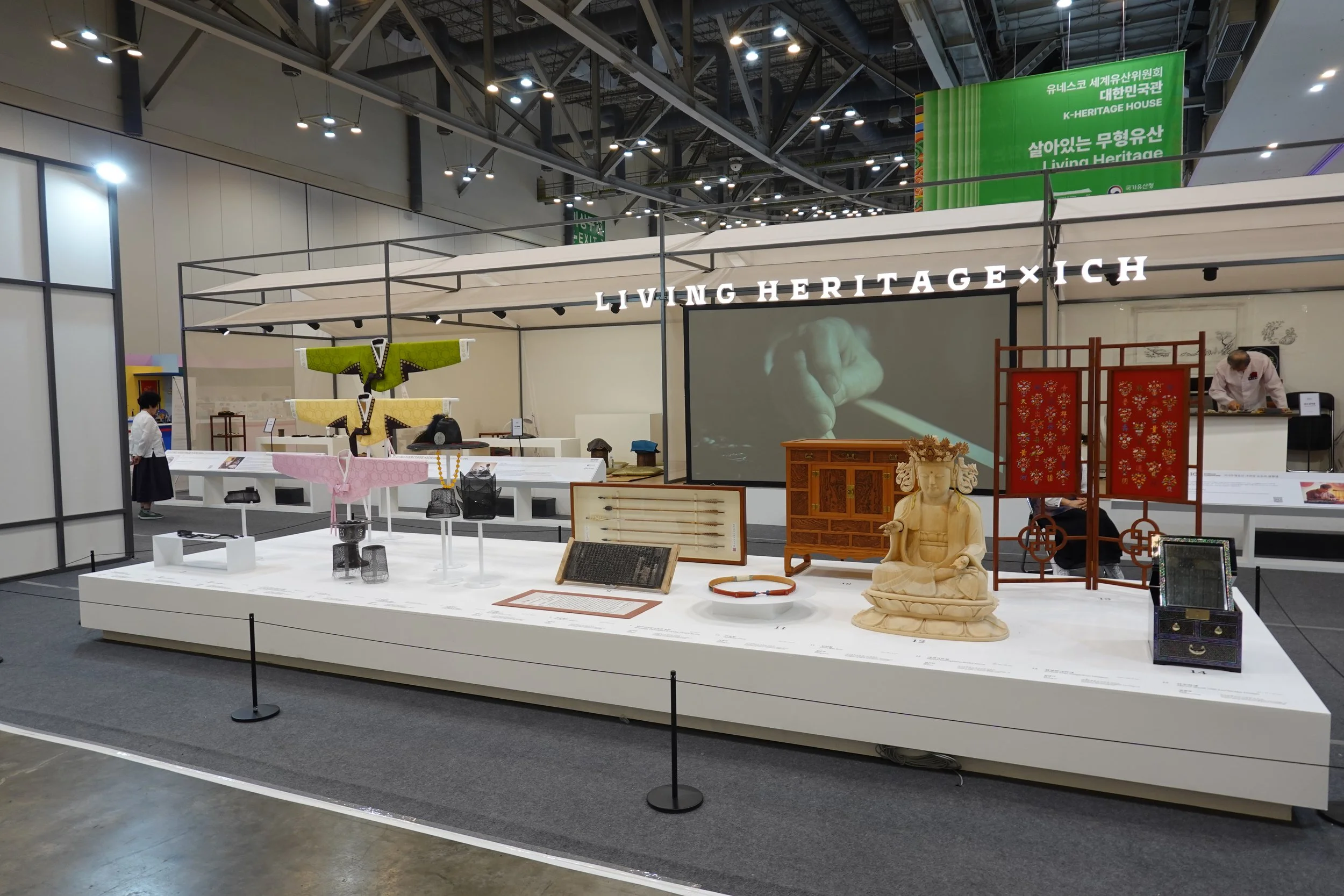
The Intangible Heritage area with, on the back, the workshops of the artisans creating traditional Korean hats. @ Mizuko Ugo
The 48th session of the World Heritage Committee was held at the BEXCO Convention Centre in Busan, Republic of Korea, from July 19 to 29.
The host country took full advantage of this international stage to showcase its extraordinary investment in culture, basing all activities in the spirit of the World Heritage Convention while placing citizens and local communities at the centre. Following the global phenomenon of K-pop, K-beauty, K-dramas, and K-food, it was now time for K-heritage to take the spotlight.
Alongside the World Heritage Committee plenary, a packed schedule of side events engaged delegates, UNESCO National Commissions, World Heritage Category2 Centres, heritage institutions and NGOs in lively, constructive discussions on pressing heritage issues [for example, see the side event on African Modern Heritage by FOPCHEN, Foundation for the Preservation of Cultural Heritage and Nature “Dialogue on 20thCentury Heritage: the Modern Heritage of Africa within the 1972 Convention”].
Moreover, a vibrant array of cultural events—including street parades and live performances— and a special exhibition on Korean cultural heritage were organized in parallel with the plenary sessions of the World Heritage Committee by 6 Central Government Agencies, 14 Local Governments and 15 other organizations such as World Heritage centres, foundations and associations.
In fact, the venue was divided into three distinct zones: two dedicated areas served the plenary sessions of the World Heritage Committee and the concurrent side events, while a third area was accessible to all visitors. This public area, called K-Heritage House, was designed to discover and celebrate both tangible and intangible Korean heritage—spanning already inscribed World Heritage sites and Memory of the World documents alongside those preparing upcoming nominations, Folk Arts tools and artisan’s workshops [fig. above].
Within this framework, the K-Heritage House was divided into four thematic areas: Heritage Future, Heritage Archive, Living Heritage, and Collaboration Zone. Together, these spaces highlighted Korean heritage not as a past tradition, but demonstrating its active, creative role within contemporary society. In the form of an expo, booths made of sustainable materials and designed with revisited traditional Korean patterns, displayed panels, models, tool kits, hands-on activity areas that stimulated the visitor to plunge into Korean heritage in all its dimensions [fig. below].
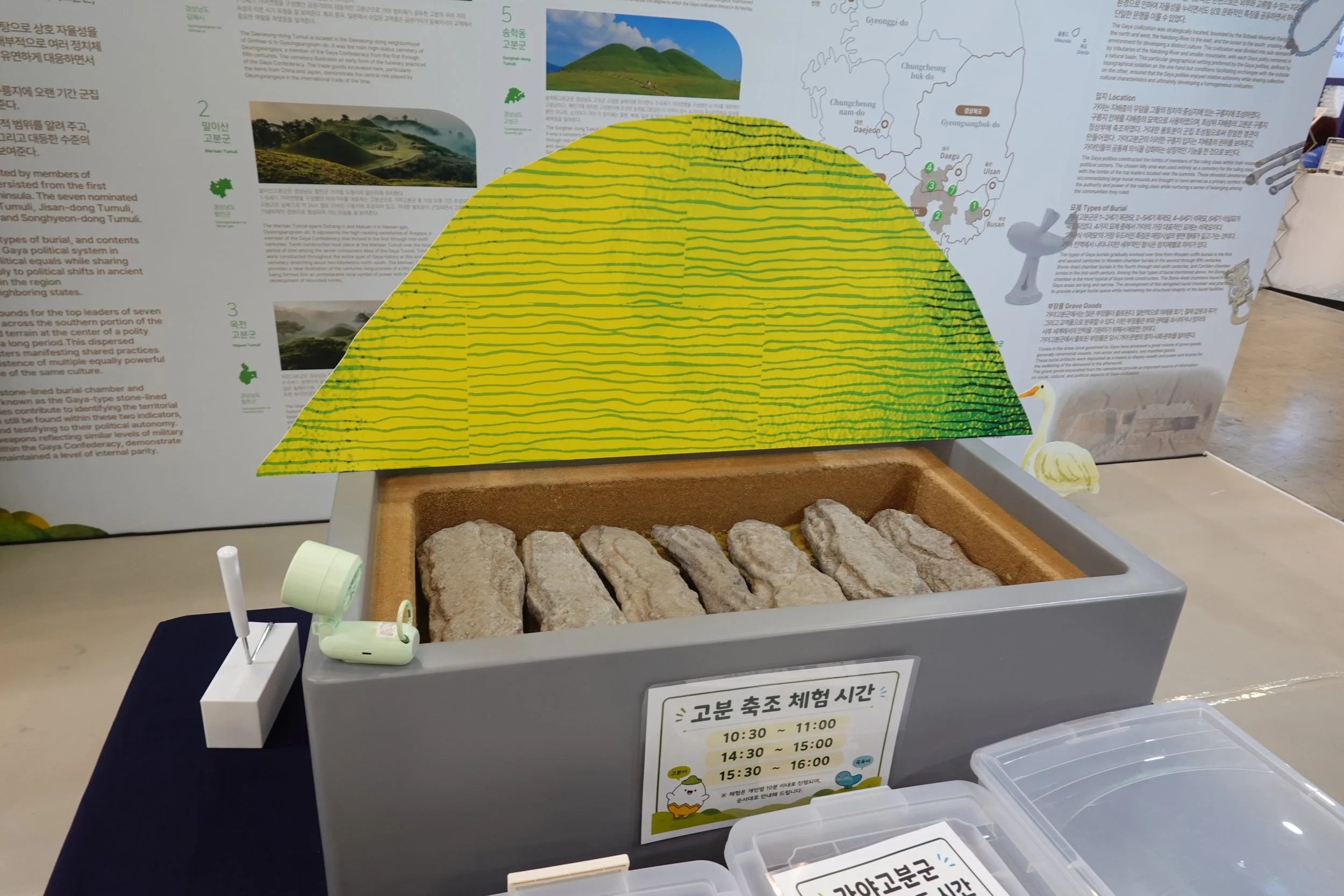
At the Gaya Tumuli booth it was possible to attend a session on how to build a burial chamber.
Immersive digital content and traditional and contemporary art were combined together to allow the visitor to best enjoy them and dig into the meanings and characteristics of temples and scents, fermented food and printing woodblocks. One of the booths showed contemporary architecture surveys and urban development, another one a digital archive of architectural building techniques and repair works (HBIM, Heritage Building Information Modeling), in another corner a 1:2 model of a traditional house explaining the regular monitoring of ancient architecture carried out by the National Heritage Care. Furthermore a digital mapping showed the complex walls of the Capital fortifications of Hanyang [figures below].
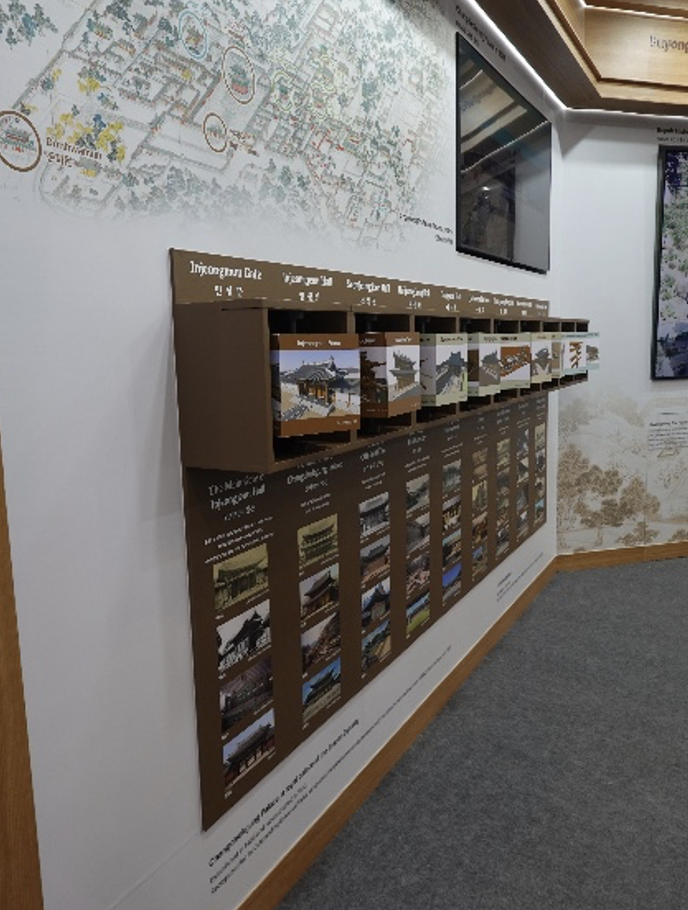
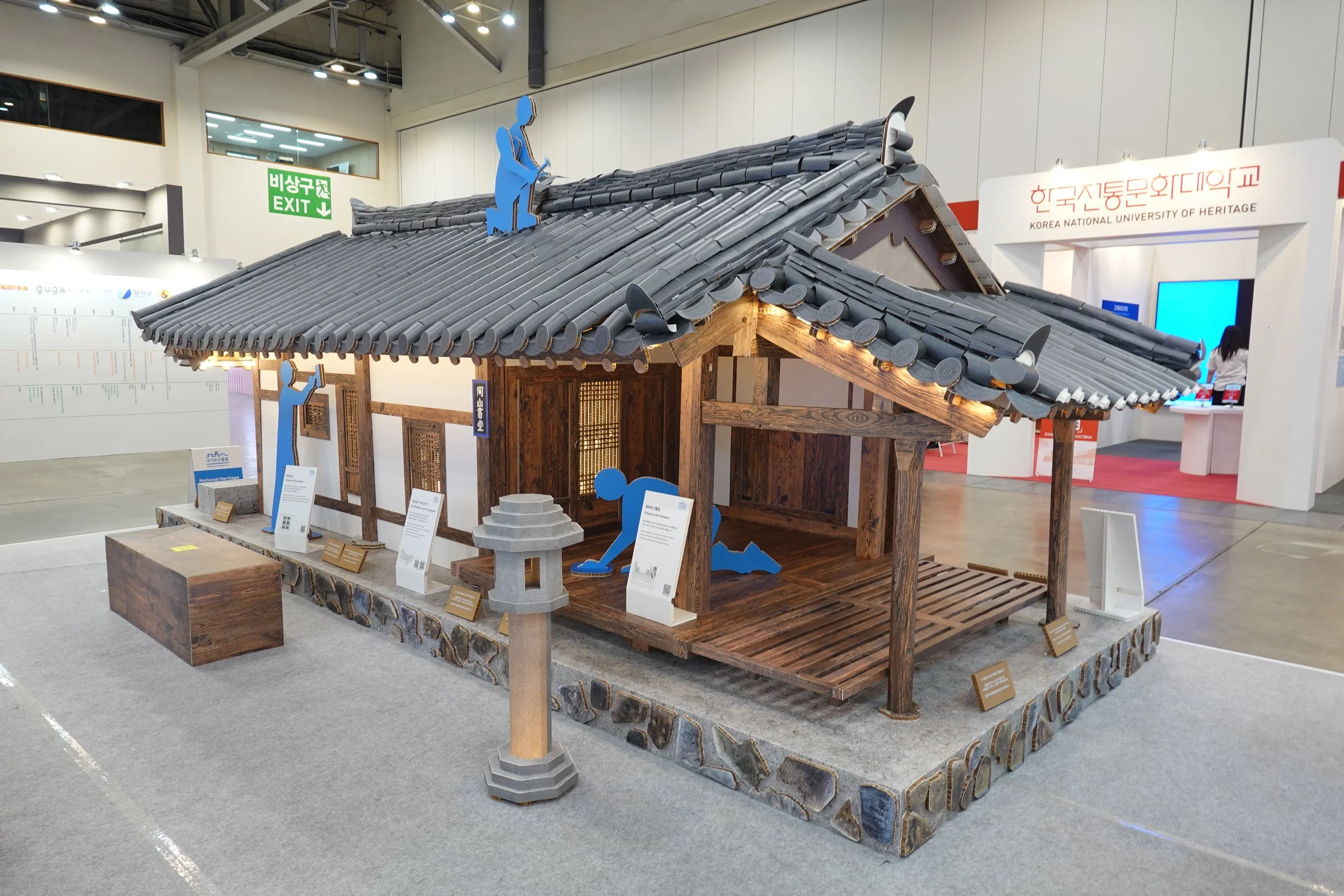
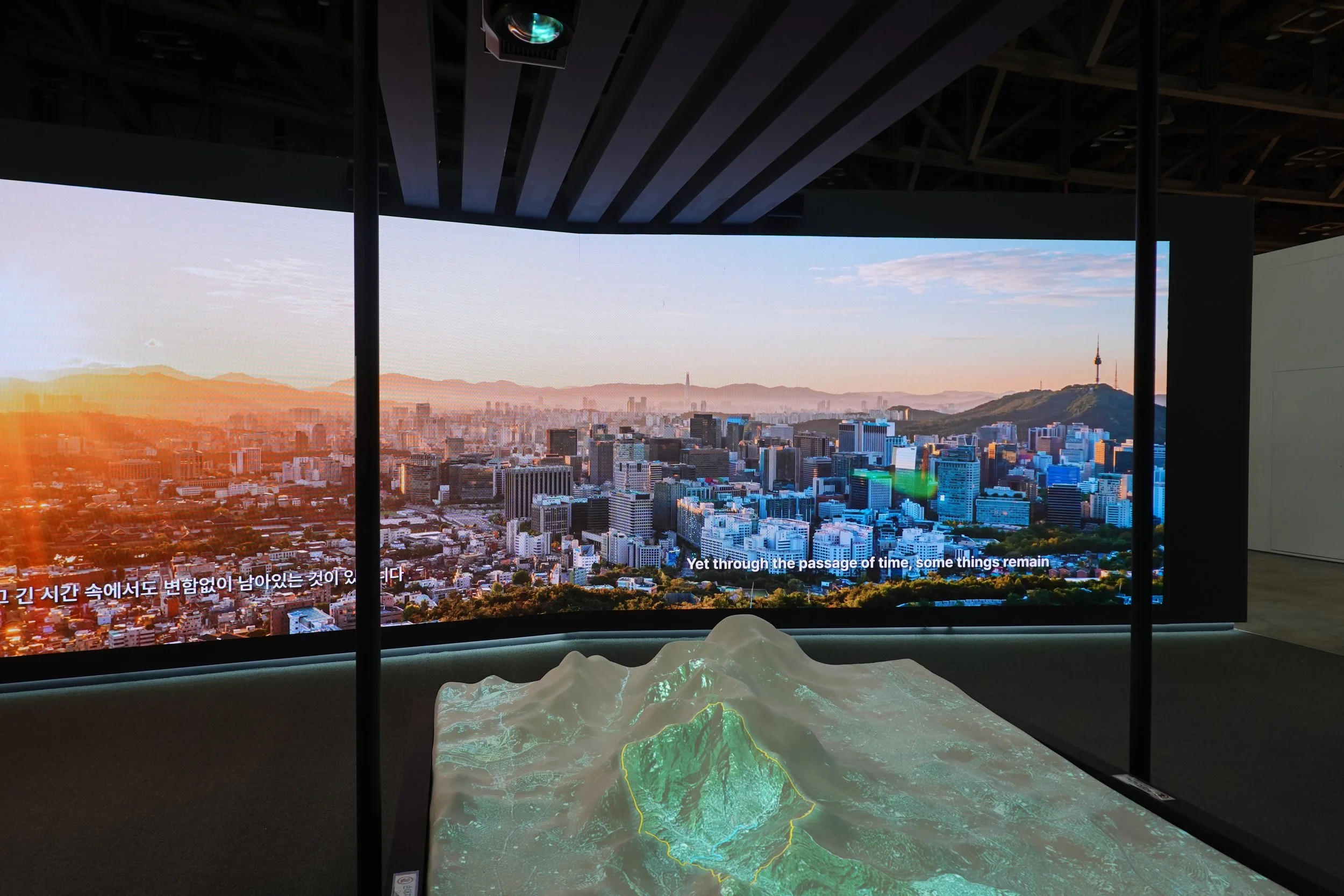
All the booths were bustling with people, lined up for several hours starting in the early morning to be able to get in and experience K-heritage.
In addition to the exhibitions and side events, an array of performances and parades animated the space outside the venue, inside the main auditorium, and across the city. Among these, the artistic highlight was undoubtedly the remarkable show “Hexagram 22” (a short teaser ad can be watched at here) This performance was specially created for the 48th World Heritage Committee. Its title refers to the 22nd of the 64 hexagrams (six-line figures) in the Korean edition of the Book of Changes (Juyeok), an ancient text that explains the principles of change in nature and humanity. Hexagram 22 (Sanhwabi) signifies grace, adornment, and beauty, which were expressed through a masterful fusion of traditional and contemporary arts to showcase the essence of Korean intangible heritage and cutting-edge media art. As in the K-Heritage House, here too the focus was on the future. Korean traditional and contemporary performing arts and up-to-date digital art were combined in a way that “preservation and deconstruction […] intertwine to expand one another” [from the “Director’s note” in the brochure of the performance].
The performance, carried out through a collaboration among Intangible Cultural Heritage holders, an electronic band, shamanic performers, lion mask dancers, and art groups, was divided into chapters. Each chapter was based on a specific concept – Breath, Voice, Line, Light, The Stage, Ritual, Harmony - expressed through the instruments and theatrical arts best suited to it—from wind and percussion instruments to songs and contemporary dance. But the emphasis was placed on the spectators who were involved particularly in “The Stage” and in “The Ritual”, where citizens brought with them one item each to show their own heritage to the audience [fig. below]. And in the final chapter, “Harmony”, all performers on stage and the audience joined together in singing the iconic folk song Arirang to communicate a message of harmony and coexistence.

The chapter intitled “Line” featured the lines of traditional crafts represented through the traditional hat known as “gat”, expressing the refined aesthetics of scholars during the Joseon Dynasty. @ Mizuko Ugo
The World Heritage Convention went beyond the boundaries of the World Heritage Committee, to expand outside into the city and its citizens. Crucially, the Busan gathering was designed not merely as a platform for experts to deliberate or diplomats to cooperate; it was a celebration created to learn about and share natural, cultural, tangible, and intangible heritage directly with the public. People were the protagonists. Bravo, Busan and the Republic of Korea!

The venue, the BEXCO Convention Centre in Busan, Republic of Korea. @ Mizuko Ugo