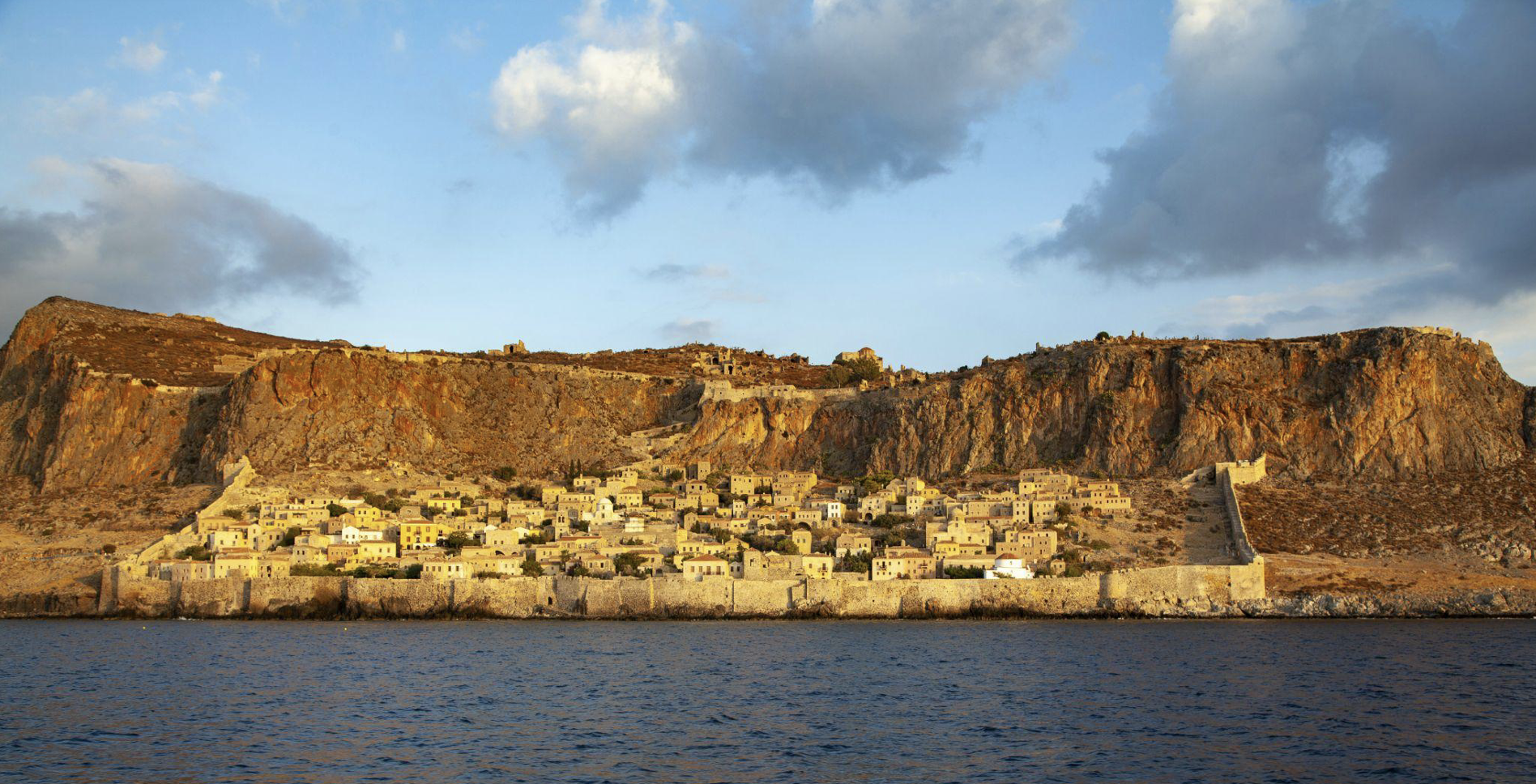
Monemvassia, Greece @ Photo by Keith Duddy on Unsplash
When an "open invitation to the local community" was announced in Monemvasia for the EU Interreg Euro-MED TO CARE MED project on Tourism Carrying Capacity Limits (TCCL), one might have expected a genuine, diagnostic dialogue about the physical and social thresholds of our living medieval castle-town.
Instead, what transpired was a masterclass in performative civic engagement.
For the vast majority of the session, residents and local stakeholders sat through an extended presentation of outcomes generated by a standardized software model—fed by data gathered behind closed doors from sources unknown. Only in the final twenty minutes was the floor opened to the public. By then, the narrative had already been set, the software framework established, and "community participation" reduced to a procedural checkbox.
As a permanent resident of Monemvasia’s Castle and a cultural heritage management professional, sitting through this presentation triggered a deep concern that extends far beyond our local rock. It exposed a growing, dangerous trend across Europe: the reliance on generic, "one-size-fits-all" digital software models that promise to manage heritage sustainability, but instead strip living sites of their spatial, social, and cultural realities.
The Fallacy of the Plug-and-Play Algorithm
The core premise of the Interreg TCCL tool presented to us is that carrying capacity can be calculated through a standardized digital dashboard. But software is only as intelligent as its spatial definition and input parameters.
During the presentation, it became immediately clear that neither the project team nor the software had established what "Monemvasia" actually meant in this context. Was the algorithm measuring the physically fragile, topographically locked medieval Lower Town? The archaeological upper citadel? The modern mainland settlement of Gefira across the causeway? Or the entire Municipality of Monemvasia—a sprawling administrative region covering over a thousand square kilometers?
Lumping a tightly constrained, highly vulnerable World Heritage-level site into the same spatial bucket as a vast rural hinterland is a fatal methodological error. A regional municipality needs economic dispersion and visitation growth; a fragile medieval monument requires strict physical and infrastructural load limits. Dropping a generic, pre-packaged software tool onto a complex site without rigorous spatial zoning doesn't produce site management—it produces noise.
"Garbage In, Garbage Out": The Veneer of Technical Legitimacy
Even more alarming was the nature of the data itself. When questioned, the presentation team candidly admitted that the numbers displayed on screen were not actual metrics from Monemvasia, but merely placeholder "screenshots" from the platform.
While dummy data is standard in internal software development, presenting arbitrary figures to a public assembly under the banner of an official EU consultation creates a false veneer of scientific authority. In computer science, the foundational principle remains absolute: Garbage In, Garbage Out.
When local governance relies on arbitrary inputs to populate a pre-designed digital model, the output cannot reflect reality. Yet, once these pilot projects wrap up, these flawed outputs do not disappear. They are bound into glossy project deliverables and submitted as official municipal "Roadmaps" institutionalizing policy decisions built on quicksand.
Behind the technocratic User Interface (UI), the software’s visitor categories reveal a complete flattening of local life. By compressing all non-hotel visitors into a single category of "day visitors" judged solely by their immediate monetary spend, the tool equates:
- A local resident from a neighboring village coming in for dinner 12 months a year;
- A property owner returning to keep a historic home alive;
- A brief visit of hundreds from a cruise ship or tour bus;
- Independent travelers, yachtsmen, or long-stay camper-van visitors.
To an algorithm, they are all just "heads" to be monetized. In fact, the tone of the meeting subtly shifted away from managing saturation limits toward maximizing extraction: asking why visitors only stay one night and how to increase their daily spend. Thus, an EU funding stream explicitly earmarked for environmental protection and limit managementrisks being weaponized to legitimize further commercial saturation.
From Monemvasia to the World: Reclaiming Civic Governance
This pattern is not unique to Monemvasia. Across the globe, from Mediterranean historic ports to European mountain villages, local communities are facing the same administrative pattern. Municipalities, eager to absorb EU funds, hire external consultancies and NGOs through direct grants to deploy off-the-shelf digital tools. These entities rarely possess specialized expertise in living historic settlements, and their primary deliverable is administrative compliance—not long-term stewardship.
When citizen engagement is relegated to a rushed 20-minute Q&A at the tail end of a pre-cooked presentation, the message to residents is clear: your lived experience is irrelevant; the algorithm has already decided.
This approach actively breeds local cynicism and resignation. When residents stop showing up to public meetings, it is not because they do not care about their home. It is because they recognize a performative ritual when they see one.
If we are to protect living heritage sites, civil society and heritage professionals must challenge the tyranny of plug-and-play digital management. We must demand three baseline principles:
- Spatial and Methodological Rigor: Digital tools must be custom-built around actual physical, structural, and ecological thresholds—not arbitrary regional boundaries or generic software templates;
- Data Transparency: Input data must be open, verified, and locally grounded before any tool is used to inform policy;
- Institutional, Front-End Participation: Residents, property owners, and local producers cannot be brought in for 20 minutes at the end of a session to validate predetermined outcomes. They must be at the table from day one as co-designers of site policy.
Monemvasia is not a digital photo backdrop, nor is it a dataset to be processed by a generic algorithm. It is a living, fragile community. If EU-funded initiatives are to achieve true sustainability, they must stop treating heritage sites as uniform numbers in boxes and start respecting the complex, human realities that keep these places alive.